Showing posts with label Trees. Show all posts

Sunday, July 30, 2017

My garden of regrets

"But though an old man, I am but a young gardener."
—Thomas Jefferson


As I tend to my garden, I think about love, loss, and regret.

All is bittersweet now. We are house hunting and that means leaving behind my gardens of dreams, regrets, trial and error, and planting new ones.

Until I fell in love with native plants and the way they nurture the thousands of exquisite creatures of this particular place on the planet, I was a fickle gardener.

I see now that was because there was no there there. There was no real life to it; no community, no history, no rightness or belonging, no center. Such a shallow-rooted relationship is not sustainable. And the roots of a garden that doesn't belong to its place disrupt the earth and its intricate web of relationships formed over the course of millennia.

So I regret years spent planting ornamental species that did nothing to feed native bees, birds or butterflies, none of which bore any kinship or relationship to the other. Fragments and echoes of another place, not this place. The harm that is done.


But though I surely regret it, the sting is lessened because I have learned to do better. Now coneflowers, hyssop, wild bergamot, milkweed, witch hazel, serviceberry and others that feed wildlife have taken their place in my plot of earth.


I regret not planting a bur oak tree many years ago (or even more recently). I told myself my yard was too small for such a wide-branching and magnificent tree...and so it is. But why didn't I plant one anyway? For I love them with all of my dryad heart. 


(A metaphor for all the ways I make myself and my life too small?)

Now I am no longer young enough to see a young oak tree grow to mightiness in my lifetime, and that cannot be undone. 

But I am searching for a house with a big bur oak tree. At the least there must be a sunny place to plant one or two, and maybe I will be granted the years to tend them and see them flourish.* But trees are a legacy we leave to the wild ones, including human persons. Trees are one (and not the least) of the joys of living on this earth.  


I love vines, the way they artfully conceal yet reveal. But at times I regret planting the too-vigorous Englemann Ivy, a selection of the native Virginia Creeper requiring constant vigilance lest it take over the garden, yard, even the big silver maple...but. Its leaves ensconce the privacy fence in green, and in scarlet, rose and apricot yellow in October.

I've also regretted letting the wild grape vine plant itself next to my sidewalk fence, where in mere days it grows foot-long tendrils that reach out into the walkway, which I must continually trim back, feeling like a meanie while curbing its exuberance. 

But on the other hand, the birds and rabbits take cover under the leaves and eat its fruit, and it is rife with large, golden, buzzing beetles (none of which you can see below).


I'm regretting the two shrubs I planted in front when we moved into this house 20 years ago...too close to one another and non-natives. I would replace them if we were staying. 

I did not instantly eradicate the dreadfully invasive European creeping bellflower that's growing among the grass in the boulevard and has spread in an unplanted area of the back yard. Another cause for regret. To get rid of it now would require many, many hours of digging, essentially replacing the entire boulevard. 

At least now I know the purple peril and in our hypothetical new yard will have my shovel at the ready, no mercy for such plant invaders that crowd out native species. 


But at least garden regrets can usually be mended with sufficient time, energy and money. 

Unlike other sorts of regrets that visit in the dark hours, all entwined with half-formed wishes, dreams, and fears. 

These are the thoughts you keep to yourself. At least, I do. It's not the place I want to live.


Regrets aside, it is a grief to leave my well-loved garden behind. Unless there was some way to know that the next person who lives here will love it, too, which there isn't. They may dig it all out and replace it with sod, which doesn't bear thinking about. 

But there is an up-side in leaving it behind: the opportunity to convert more useless lawn to native plantings, and a fresh start. Anyone who says you can't leave your problems behind wasn't talking about a garden, because you definitely can. 

Maybe I will dig out a beloved plant or two to take with me to inaugurate my new garden, wherever it may be, along with everything my regrets have taught me. 


*Not only are bur oaks magical and magnificent beings in their own right, they also support over 600 species here in the Great Lakes region. If it is native to your homeland, plant one. Don't wait!


Monday, May 29, 2017

The scent of sacred spring


In times gone, and maybe still in places where they pay attention, they call this one Queen of the May, under the protection of the faeries. 


Hawthorn has more charisma in one wild, twisty branch than does a whole hillside of uniform cultivars. 

Of all the varieties of hawthorn at the Arboretum, she was the only one to be blooming as early as the flowering crabs. 


Hawthorn's fragrance midway between narcotic sweetness and a whiff of fermenting flesh...but nonetheless (or maybe because of it) her branches were humming with small, darting wild bees and honeybees and syrphid flies, all dizzy with nectar amid the flowers and thorns.


Hawthorn marks the entrance to the Otherworld. 

In the Old Lands, they told the tale: 

On your life, do not cut down the sacred tree. 


Take care to not interfere with the lone bush growing in the open, for a temper dwells within this tree. 


Ask permission before gathering her flowers. 

And leave an offering in return.

Hang the may boughs over doors and windows for protection from witches and Unseelie spirits...


Do not bring the blossoms inside! For ill luck or death may follow.†


(I have a witch sister who planted a hawthorn outside her kitchen window. But she was disconcerted by the flowers' heady, sweet-decomposing scent, and later removed the tree. 

I wonder, did she ask permission? Hawthorns seem unusually testy. See their thorns, up to four inches long....)


Hawthorns, genus crataegus, are cousins of apple trees and Juneberries within the large rose family. 

Many thousands of years of lore and legend around hawthorns grew up like wild hedgerows in the Old World. 

So many alien species did European immigrants bring to North America that one could be forgiven thinking that any hawthorn one finds in America must have originated elsewhere.


Whoever thinks that, I have discovered, would be mistaken. Because the royal family of hawthorns has for just as many centuries been native to North America, including seven species native to my northern region:

  • Dotted hawthorn (Crataegus punctata)
  • Downy hawthorn (Crataegus mollis)
  • Fanleaf hawthorn (Crataegus flabellata)
  • Fireberry hawthorn (Crataegus chrysocarpa)
  • Fleshy hawthorn (Crataegus succulenta)
  • Pear hawthorn (Crataegus calpodendron)
  • Red haw (Crataegus chrysocarpa var. chrysocarpa)


New World hawthorns seem to have grown a thorny history of their own, one unfamiliar to me. As remedy, in my stack of reading is Hawthorn: The Tree That Has Nourished, Healed, and Inspired Through the Ages, by Bill Vaughn, guardian to acres of wild hawthorns on his Montana property. 


One day, perhaps at our new house, if we ever find it, I will plant hawthorns in my yard, and their fragrance shall be intertwined always with the unfolding, intensely mortal beauty of May. 

With Faerie queens, storm-colored clouds, changeable skies and the luna moth of spring.

But for now, Juneberry, Witch Hazel, Pagoda Dogwood, Crabapple and Silver Maple are my everyday companions, and I must ramble with intention to see hawthorns, planted as ornamental trees in the parklands around my home. 

No hedgerows, rag trees, or fairy bushes here. 

But still, magic. 

See now the small soft-feathered mother, American Robin, who has made her nest amid a bower of hawthorn's protective thorns; where the flowers will soon flutter to the ground and the tree will set fruit, growing red haws beloved of thrushes and waxwings. Which they shall eat and then plant without even knowing that they do, so that in the way of kinship, more hawthorns can protect more robins. 


†"A widespread belief in Ireland, and elsewhere, was that hawthorn blossom was unlucky. A recent survey carried out by the Folklore Society in Britain found that hawthorn flowers were considered to be the most unlucky of plants, with death resulting if brought into a house. Recently it has been shown that a chemical present in the early stages of tissue decay is found in hawthorn blossoms, so perhaps an association with the smell of death is the cause." —Niall Mc Coitir, Irish Trees: Myths, Legends & Folklore, (c) 2003. 

Sunday, March 20, 2016

So early in the spring


Early in the springtime, my lungs need oceans of air. [an everlasting wash of air.]


A huge expanse of sky, where eagles circle...where human eyes can rest on a vast vault of wind-washed blue softened by cloud.

(Do you see her up there, the glorious winged one? Did she hear me speak to her in praise as I moved below, so small and large-hearted through the wildlands?)


Trammeled by months of dimness, small screens, small rooms, small gaze—so close to warmth of hearth, breathing the small air of home—my mind rests on these broad sweeps of land.

The particular beauty of trees on a rise that I have loved for my whole life without ever tiring of their speaking branches, of their shapes curving against the sky, so individual in their ways, complete in themselves.


Before I am ready, I come up against a boundary. [Then the good minute goes.]

It sends my thoughts racing ahead, worrying against peace's edge. Once the boundary-less becomes bound, my large breath begins to shrink...until the wind rattles the grasses, the red-winged blackbirds chirr, and there I am again, back to where I stand.


If you live in a place where the ground does not freeze, then you miss the pleasure of the thaw—that receptive, bodily feel of the earth under your foot yielding once more to your weight, a sensation you may not have even realized you had lost until it is restored to you. It reminds you that the earth is your beloved.


How fair you are, young birch sisters, I think.


Red-osier dogwood, bright kinnikinnick, you that the native peoples honored, I send you good greetings.


O oak-crowned hill, do you feel the reverence with which I approach you? Maybe the rustle of your leaves as I pass is for me.  


On this day, you feel once again in conversation with this earth, like catching up with a relative you have not spoken with for many months, though you were sometimes lonely.

It is more than walking on. Together you walk, reunited.

[Two in the campagna.]

Monday, February 15, 2016

Prairies like palaces


Long ago, I visited the Amalienburg in Munich, a rococo hunting lodge built for an emperor.

The jewel box Hall of Mirrors there is pale blue like this sky, with branching silver tracery and silver sunlight pouring in through wavy glass, and the trees in the parkland outside grow into infinity in a round of silvered mirrors.

All in a circle, like a glade of silver-white birches in the snow.


 I scatter seed on the ground for sparrows. 

For blue jay, peanuts. 

Suet for woodpecker. 

As dusk falls, rabbit will creep out under the moon and glean whatever is left. Tomorrow I will find her small pellets left in the hollows of my footsteps. 


I gaze out at leaden skies and snowflakes falling down, up, sideways, uncertain as feathers riding freezing breaths of wild air.

But once the clouds make the snow, it must needs land. Finally it will settle, on branch, shingle or ice-slick ground. 

Birds speed past. Cold. Yet this morning I heard a cardinal outside my window, singing his breeding territory song, and now the eagles warm and shelter their clutch of three eggs from harm.


Sunday, March 16, 2014

Tending is a kind of making


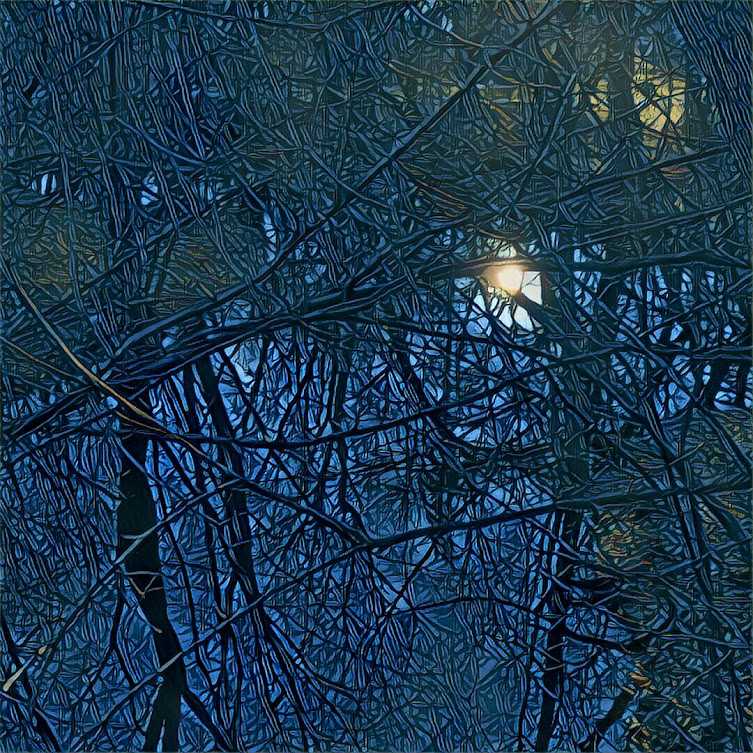
Last spring, my shade garden through a knothole. 


Tomorrow is the day I will reserve a tree through my city's annual tree-planting program.

Only $25 for a well-grown tree, to bring home in mid-May, when it is finally safe for young living things to go into the ground here. 

It is a naturally branchy creature, this Serviceberry--a multi-trunked bird magnet with pure white blossoms in spring, juicy dark berries in June and glowing, orange-wine leaves in autumn.


(An oasis for the spirit shall she be.)


This little tree will need to be adaptable to thrive in her spot between the underground utility lines and the overhead power lines. She will need to bear up against strong north winds in winter.


(Great expectations already are heaped upon her young shoulders.)


Some choose to prune and school this tanglewood into a neat, single-trunked tree. But not I. My Juneberry can branch as much as she likes.

Because my eye is ever searching for a heartful place to rest between the window and the sidewalk, and the yard and the street, and the parking lot beyond that.


(A sight that brings peace and sweetness. These days, I collect them.)


When the Serviceberry tree, also called Juneberry, begins to bear fruit, ah. These are the days of celebration! 

As the birds come and go, swooping to devour every last berry, I will smile. 

At that moment, I shall feel the best feeling. Like a child of the earth. A wildling mother. A midwife to beauty.


(I'm feeling it now.)


Sunday, December 15, 2013

Kindredness & kindness

I've been applying for a lot of jobs lately. But in my heart, I want my life to be branching like a tree, silhouetted in bare grace against the winter sky. No more trammeling myself into spaces that feel small. No trying to impress, convince, persuade. Trees, stones, water, birds...nothing on this earth ever tries or wants to be other than itself, except for us. They just are.

I mean, look at the trees, stripped to the bone. That essential being-ness of trunk and branch is like a song traced against the sky, a quiet refrain repeated from tree to tree. Each a living being, and also a branching map of its own life. Like a human, specific to itself in its particulars; and again like a human, akin to others of its kind. Unique...yet not alone.


Along with the job seeking, one of the things I've been doing rather than writing blog posts is gathering photos of crones. Over and over, I am struck by how so many of their faces shine with joy and radiate such love and acceptance. I feel wrapped in an embrace just by looking upon their beautiful faces. How diminished we would be without the grandmothers and their wisdom--a cauldron of power that has distilled over the course of many-years-lived into its bare-branches-against-the-sky essence.

By looking at photo after photo of women who are wholly who they are, I hope to honor that essence in others and nurture it in myself. It's a kind of choosing. A kind of reminding, envisioning, invoking: This is the kind of woman I want to be, how I want to grow old. Like a grand, twisting tree, like a wrinkled and happy and lovely old woman, enough in myself.


I've been thinking what a gift to the world that kindness is. How powerfully it affects us when we are touched by another's kindness, and how we long to be accepted and to belong. That longing must always be there, underlying surface-dwelling things, like a tender nourishing stream beneath the tangle of tree roots.

It is never so clear that the longing exists as when a stranger unexpectedly smiles at you, or a small child you do not know reaches out her arms toward you and laughs, just at the sight of you. Suddenly, you feel yourself light up from within, a welling of joy and gratitude for being seen for who you are: Nothing more and nothing less than a human person walking in this world, over this ground, under these stars and these clouds, following a path and singing a sometimes-brave, sometimes-wavering tune as you go.


Mary Oliver wrote, "You only have to let the soft animal of your body love what it loves." And "When will you have a little pity for every soft thing that walks through the world, yourself included?"

It takes such a small act of kindness to ourselves or others to swell that small, unseen, tree-rooted stream, and to feel its nourishment. Then compassion arises feeding healing tears, as we accept ourselves and are accepted by others, at the root. That is how our hearts expand, sending out tendrils and branches toward others, like a beautiful tree during the crone-time of winter, still swelling buds and green with life within.

Friday, November 15, 2013

How it falls


ON THE DAY OF THE BEAVER, a day when the winds were calm, I tried paying attention. Maybe for the first time, I saw how maple leaves fall stem-first, spinning around their own axes like golden goblets then landing upright for a moment where grasses are thick.


I paid attention to the course of oak leaves. Burnished and glossy, heavier than maple leaves, they drift through the air on their backs...swinging to and fro like small pendulums marking time.


Deeper into autumn, on a day when the Lords of the Winds gusted mightily, I paid attention as the leaves flew sideways like fleeing birds, driven far from their trees instead of heaped at their roots.


As I lay on my back on a leaf blanket, paying attention, my eye was drawn again and again to this particular oak tree. It was so beautiful, with its speaking contours, the contrast between its bold branchings and bronzed leaves, which flashed like spangles against the sky. Reminding me of the woods through which the Twelve Dancing Princesses progressed on their way to their mysterious nightly revels: a forest with leaves of silver, a second with leaves of gold and finally, closest to the enchanted castle, a wood whose leaves sparkled with diamond dew drops.


The authors whose works I have been reading suggest that that particular tree was speaking to me, which is how it drew my attention; communicating with me in the way of a tree person to a human person. Color is a kind of speech. Sound and movement, as well. They can inform us about weather, season, health of the tree. But is there more to interpret? What else was being communicated?

While I am used to sending feelings (and words) of praise and gratitude to trees, is that is as far as the reciprocity extends? Perhaps the images and associations they spark are more than just my own mind at work...maybe it is more mutual, a kind of conversation between my mind, my intuition and the other beings around me? Co-creating the world?

I am not entirely certain how to receive that which a tree may want to tell. But it likely begins with cultivating a state of openness, and...paying attention.


Priscilla Stuckey in Kissed by a Fox writes, that though the typical American knows how to work or make use of the land, "Far less often do we stop to merely gaze at the land, open-eyed--to watch it, as students, over time....Knowing where we are takes attention. Sustained looking. Seeing. Becoming rooted in the place we live, whether bright desert or blustery mountain, dark woodland or windy shore."


She also writes: "Though many modern people express a longing for lost wildness, what I think we are really missing is personality--the integrity of place. A relationship with the unique piece of Earth where we dwell, an ability to see its deep character."

And: "Among my people, children are taught to read books; among some other peoples, children are taught to read trees."


My musings: For a person who has not been taught to read trees, watching a leaf fall to the ground and noticing the way in which it falls is one small way of paying attention. It is part of learning to be literate about the personality and ways of an oak or a maple, the winds, this particular land, and its non-human inhabitants.

The immediate rewards to paying attention to this other-language: a sense of peacefulness, calm and well-being. A few moments of restfulness from the brain chatter. Slowly I am shifting a small part of my way of being, from interior, ruminative, dichotomous and feeling apart to one more observant, receptive and "part of."

This keeps me feeling young...young, as in, the world fascinates and surprises me. As in, there is more to the world, Horatio, than is dreamt of in my philosophy.

Maybe it is as Mary Oliver wrote, and I did not have ears to hear it until now:

"Whoever you are, no matter how lonely,  
the world offers itself to your imagination,  
calls to you like the wild geese, harsh and exciting -- 
over and over announcing your place  in the family of things."