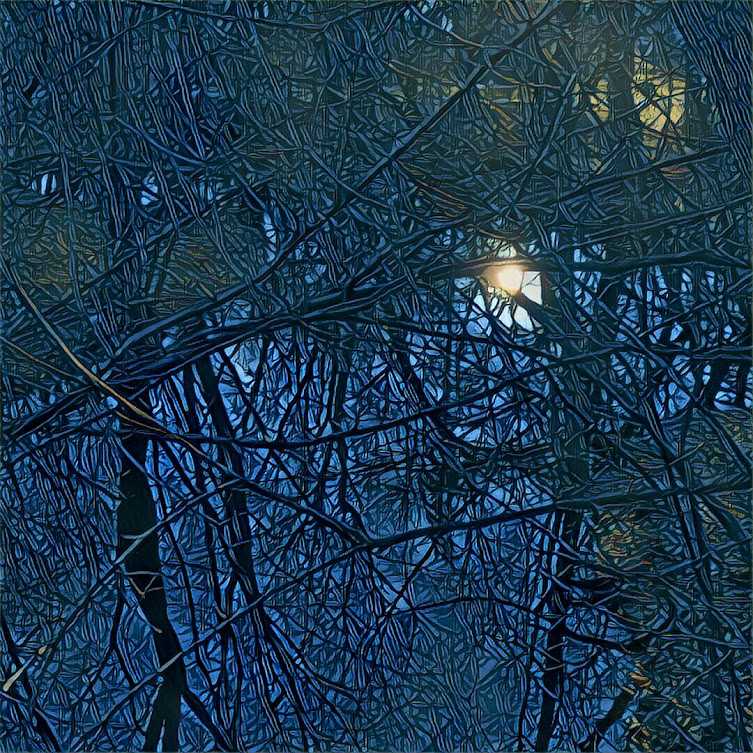
I haven't had words to say lately. Not that I wanted to release to the world. Just uncertainties and a heavy inertia. Layers of cloud now and then lit up by chasing beams of light that fade as quickly as they come.
Sun Kil Moon's music puts sound to this clouded and cold Midwestern sky. The dull light, empty fields, crumbling roads, broken glass underfoot become beautiful in their emptiness. Heart-hypnotizing Great Lake hymns like the sound of silent sunlight flickering on a wall. Sadness enveloping joy, bare branches trying to flower.
Nothing makes me happier and more filled with hope than a redemption story: the mended-wing owl released into the wild, the neglected weedlot patiently transformed into a bee-humming garden, the painting dimmed by time that's restored to its original glory.
I am coming face-to-face with these stories lately, in the way that our brains seek and find that to which we give our energy and thought.
Spending one long afternoon exploring a reconstructed native tallgrass prairie and oak savanna, I found myself in the midst of one.
Before the Europeans came to North America, tallgrass prairie and oak savanna (a transitional landscape between woodland and prairie) covered much of this area. The fertile soil called "prairyerth" once supported millions of animals, birds, insects, reptiles and plants. Now, only a tiny fraction of a fraction remains.
That is a profound loss and a great sadness. How many oak trees, I wonder, were felled in this square mile, to convert the savanna to farmland, in the years before this house we live in was built in 1922?
But this is where the hope comes in. Many, many people are mending. Restoring what was. Healing the land in all sorts of inspiring ways.
And the blessing of sadness is that it makes you more open to everything that is sad, and also everything that transcends sadness, or that has been made whole; like the subtle magic of a wide-sky, wind-tossed prairie reclaimed from farmland.
"She who tells the prairie mystery must hear the prairie in her heart." --William A. Quayle
"I would be converted to a religion of grass," writes novelist Louise Erdrich, then goes on to describe what the prairie tells us: "Bow beneath the arm of fire...Be lovely and do no harm."
Coming around this curve, my eye was caught by the sunlight glowing through two large ears, belonging to a white-tailed fawn across the grass-scape, resting as her mother grazed a few feet away.
We watched each other in stillness, each in our own species-sphere. Long enough for me to take a photo. Then the doe caught my scent and together they bounded off into the brush, flashing their tails. I heard them circling back around in the distance, heading into the woodland over the hill. So I waited for them to get away so that they wouldn't feel pursued.
It was like walking in a neverending present, in a place that felt intensely itself.
Red Admiral
Flowering Spurge
Of this particular redemption story, Al Johnson, who undertook the reconstruction in 1965, said, "Although the process is slow and painstaking, we feel the results are well worth the effort...The flash of blazingstar and sunflower in the summer, the waving of bluestem and Indian grass are sights that as they grow rarer, become more precious to us and our children."
Rough Blazingstar
Tall Blazingstar
Boneset
Echinacea
"To see and know a place is a contemplative act. It means emptying our minds and letting what is there, in all its multiplicity and endless variety, come in." --Gretel Ehrlich
My next mending project: Dig out the daylilies behind my garage and put back a bit of prairie.
Prairie quotes from the Bennett/Johnson Prairie Field Guide.
You live in a small, dusty Midwestern town, sometime in the 1930s. A town of creaky screen doors, faded flower-print dresses waving on clotheslines, chicken coops, cornfields and white wood-frame churches, where the night sky is still lit only by fireflies and the Milky Way.
It is an utterly ordinary dusty town. People listen to the radio in the evenings after they wash the supper dishes, and the only strangers occasionally encountered are the neighbors' out-of-town relatives or the door-to-door salesmen who come from other small and dusty towns.
And it is so dark and quiet at night. Quiet with a fine, silvered silence broken only by hoot owls, crickets, nighthawks and the rustle of the corn as the fox slinks through the stalks.
The townspeople mostly close their windows to this particular music, since warmth and safety can feel hard to come by.
One day in late autumn, when the harvest is in and bees cluster in their hives—an overcast day, when crows roost in the bare branches and caw loudly at small boys—a gypsy wagon with faded paint and gilded rosettes sets up on the edge of this dusty town.
Nobody knows where the wagon came from, or what it's for; but, being so unexpected, so unusual, the wagon (and the odd sounds that come from inside) stirs up a wondering that slowly builds as the afternoon passes.
Finally that evening, the townspeople hear the winding, beguiling melodies of a strange music wafting over the corn fields. Composed of accordion and clarinet and fiddle and they don't know what all...but the woman's voice calls to them, so they shrug on their coats and go, walking in pairs or bunches as the excited children race around them in the dark. After all, despite the dullness of their ordinary town, aren't they as curious as any other human creatures? And as drawn to magic and mystery?
So they gather on the edges, in that liminal space between town and not-town; wild and not-wild. They gather in the dark, under the moon, by the light of the leaping violet fire, where a ragtag company of musicians play well-worn instruments late, late into the night. Laughingly they gather on hay bales set around the encampment. Some close their eyes and sway slightly as the otherworldly, dark-velvet music enwraps them. Some shyly waltz together in that hinterland where the flashing edges of the firelight dance with the darkness.
And for a while, they are reminded that this world, which encompasses and breathes through themselves and every other living thing, is an enormous, unfolding story, of which each is part. That darkness is the other side of brightness, and joy the other side of pain.
The music to which they danced and dreamed that night sounded like this.
Ashes
Celebrate
Dark Dark Dark are based in Minneapolis, Minnesota. While they don't to my knowledge travel via gypsy caravan, they do tour nomadically around the world.
The rain fell all day, out of a pewter sky, pelting away at mushy piles of snow. I wound garlands of blue twinkle lights around the picture window, the dining room door frame and the built-in buffet; a festive glow to lighten the dimness.
Dark as it is, the rain sounds like silver...hissing under tires, slurrying down icicles, ringing and puddling in crystal hollows. Silver is the color of December for me: Silver snow, moon, bells, stars. Silvershine, silverlight, silvershiver. The tiny, precious silver beads my mother used to decorate gingerbread men, that lay silver-sweet on my child's tongue.
I love both of these songs that have silver in their names—there is a sort of slow majesty about each of them. Adam Sparhawk and his wife Mimi Parker are the gorgeous voices in Low, an indie band based in Duluth, MN, that has opened for Radiohead and periodically tours around the world. Singer-songwriter Haley Bonar, from South Dakota, also lives in Minnesota and has opened for Low.
One night a few years ago, I went downtown toThe Entry to see Jason Molina,
an Ohio singer/songwriter who was on one of his restless highway tours of
middle America and Canada. The Entry is an intimate venue that adjoins the more
famous Mainroom at First Avenue, holding maybe 200 people inside its black-painted
walls.
I went alone that night, because a. though I’d been a fan
for a couple years, I didn't know anybody else who even knew who Jason Molina
was, and b. so I could completely sink into the experience without having
to pay the slightest attention to anything or anyone else.
I got there early, staked out my place behind the rail, and when
he and his band took the stage, I tried to drink in every note he sang. Feeling
as if that music was feeding my heartlander's empty places: those wide,
unpeopled plains unfolding beneath a bright moon.
The prairie and empty highways throb like a pulse through
this man's songs. He casts a spell woven of stripped-down sadness, minor chords
and powerful, dreamlike images: wolf-headed conjurers, thunder and crows,
ghosts and dust, bluest-blue and blood-so-red and a moon that swings like a
blade over the Midwest's heart.
"I know serpents will cross universes to circle around
our necks
I know hounds will cross the universe to circle around our
feet
They're always close, always so close
Step by step
One's beside me
To kill me or to guide me
Why wouldn't I be trying
To figure which one out?"
"Ring the Bell" - Songs: Ohia
His songs—the ones I love best—are stark, haunting,
yearning, like a soundtrack to the rare dreams that inhabit you for hours after
you awake, so vivid and strange are they...an urgent voice in a strange
language that nonetheless is clearly calling you to pay attention: a vital
message is being sent from your deepest dreaming.
Exquisite songs, with an elemental power rooted in sadness,
and in the beauty of vast, moonlit landscapes...
Two Blue Lights
...songs of unspoken farewells...
Nervous Bride
...passionate, eerie, skin-shivering songs.
Coxcomb Red
Now you know who Jason Molina is, too.
Speaking of a recent album, he said: "So in a way, these are meditations on depression,
waiting, dislocation, separation, doubt, fear, loneliness...the usual from
me...but here, if I did not see redemption or even a glimmer of hope, and
thought I could put that into lyrics and a simple melody, I allowed that to be
the driving force of the song.... All of this is an attempt to put a serious
price on lyrics that are honest not witty, shy but not weak, weary if they are
and sad without apology, depression without a fight and depression with a
fight."
After the Entry show, I hung around to thank the man, in a
sincere but inadequate effort to express what his songs mean to me. As I spoke,
his kind face lit up, he took my hand, and he thanked me for coming to see the
band.
Jason Molina has been on hiatus the last couple of years, as
he battles some demons. I, and many others, are hoping hard that he finds the redemption
he is looking for.
.
Addendum.
Jason Molina died on March 16, 2013, from organ failure related to alcoholism. He was 39.
We will try and know whatever we try
We will be gone but not forever
The real truth about it is there ain't no end to the desert I'll cross